
Americans Just Paid Down $4.8 Billion in Credit Card Debt. Here's How to Make Next Month Yours
Credit card balances posted their steepest monthly drop since 2024, even as consumer sentiment hit a near record low. Here's why cards fell while other borrowing rose, and what to do about yours.
October 9, 2026 · 6 min read
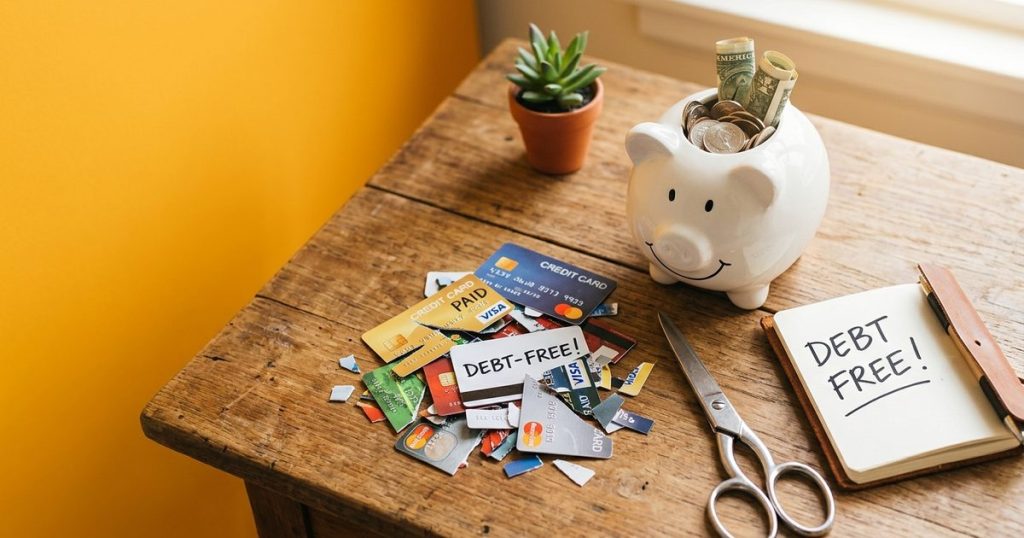
Something quietly good happened on Wednesday and almost nobody wrote about it. Credit card balances across the country shrank in August, by $4.8 billion, the steepest one month drop since November 2024. The reason has very little to do with how anyone feels about the economy and a lot to do with arithmetic.
First, the number
Every month the Federal Reserve publishes the G.19, basically the national tally of what Americans owe outside their mortgages. The August edition landed Wednesday afternoon. Revolving credit, which is mostly credit cards, fell at a 4.2% annual rate, dropping to $1.352 trillion from $1.357 trillion. Total borrowing still rose $8.3 billion, but that was barely half the $15 billion economists surveyed by Bloomberg expected, and the smallest increase in three months.
So cards went down while everything else went up. Hold onto that shape, because it explains the rest of this.
Meanwhile, everyone says the economy feels awful
This is what makes the paydown interesting. The University of Michigan’s consumer sentiment index, running since November 1952, came in at 47.8 in September, the second lowest reading in the survey’s entire history. The only month that beat it was May of this year, at 44.8.
People also expect prices to keep climbing. Michigan’s inflation expectation for the year ahead jumped to 4.6% from 4.0%. The New York Fed’s separate survey put it at 3.9%, the highest since May 2023. Joanne Hsu, who directs the Michigan surveys, noted that “year-ahead expectations for both personal finances and business conditions plunged.”
Here’s the twist. Those same people are not expecting to spend less. The New York Fed found households expect their spending to grow 5.5% over the next year, also the highest since May 2023. And the share who think they might lose their job in the next twelve months fell to 13.5%, the lowest since December 2024. Read those together and you get a fairly clear picture: Americans are not scared of unemployment. They are scared of what a cart of groceries costs.
Cards got expensive, so cards got boring
The average interest rate on credit card accounts that actually carry a balance hit 22.36% in the third quarter, up from 22.15%, and the highest in a year. Across all accounts, including the ones paid off every month, the average is 21.19%.
That number deserves a moment. At 22.36%, a $5,000 balance you never touch costs roughly $1,118 a year in interest. That’s about $93 a month that buys you nothing. Not groceries, not gas, not a weekend. Ninety three dollars for the privilege of owing five thousand. When borrowing gets that costly, paying it down becomes the highest return move most households have. You cannot reliably earn 22% on anything. You can reliably stop paying it.
Why car loans went up while cards went down
Nonrevolving credit, meaning auto and student loans, rose $13.1 billion in August, and auto sales hit their fastest pace since April 2025. That only looks contradictory. Revolving credit is the one piece of your debt you can change this month. A car loan is a contract; you signed it, the payment is the payment. A card balance is a dial you can turn in either direction between now and your statement closing date. So when money gets tight or expensive, the card balance moves first. That’s exactly what August looks like.
Which move was behind any one household’s drop, deciding a 22% rate wasn’t worth carrying anymore, or simply having less room to add new charges, isn’t something the G.19 can tell you. But both paths run through the same two numbers: the rate on the debt, and which debt can actually be adjusted this month. Neither one requires anyone to feel any differently about the economy. That’s the case for arithmetic over mood.
One thing worth untangling while we’re here: paying down a credit card is not automatically the same as spending down your savings. If those extra payments came from spending less elsewhere, that actually counts as saving more, not less, since cutting spending and reducing debt are both ways of building up what you own. It would only pull from an actual savings account if that is specifically where the money came from, and nothing in this data says that is what happened.
Worth knowing: car loan rates climbed too. The average 60 month loan from a commercial bank hit 7.54%, up from 7.14%, and 72 month loans run around 7.2%.
Here’s what I’d tell a friend
If you’re carrying a balance right now, you’re in the company of a few million people and a 22% rate nobody chose. Start by finding your real rate, because most of us know the number from the ad rather than the one on the statement. Then, if a balance transfer offer is sitting in your inbox, compare it honestly: a 3% to 5% transfer fee against 22.36% for a year is usually a trade worth making, as long as you have a plan for the month the promo ends.
One more flag. Card issuers now let you split purchases into fixed monthly installments, and use of those plans jumped from 23% of consumers in April 2025 to 36% by March 2026. They can be cheaper than carrying a revolving balance. They can also quietly stretch a purchase across a year. Read the fee before you tap yes.
What you can do this week
- Pull up your last statement and find the “interest charged” line. Not the promotional rate, not the range in the terms. The dollar amount you actually paid last month. That is the real number.
- Pay before your statement closes, not just before the due date. Card interest accrues on your average daily balance, so an earlier payment shrinks the balance the interest is calculated on.
- Compare one balance transfer offer against doing nothing. Transfer fee times your balance, versus 22.36% for twelve months. Side by side, the answer usually announces itself.
- If a car is in your near future, shop the loan separately from the car. At 7.54% for 60 months the financing is a real line item, and the dealer’s rate is rarely your only option.
- Check your savings rate against your card rate. Money earning 4% in savings while a 22% balance runs is a losing trade for every dollar above your emergency cushion.
August’s $4.8 billion was a few million ordinary decisions stacked on top of each other. September’s number comes out in early November, and there’s no reason yours can’t be part of it.
Sources
- Consumer Credit – G.19, August 2026 — Federal Reserve Board, October 7, 2026
- US Consumer Borrowing Moderates on Drop in Revolving Credit — Bloomberg via Yahoo Finance, October 7, 2026
- Consumers Get Choosier About Credit — PYMNTS, October 2026
- Survey of Consumer Expectations, September 2026 — Federal Reserve Bank of New York
- Consumer sentiment falls to second-lowest level on record as inflation expectations rise — Scotsman Guide, September 2026
- What to Look Out for in Economic Data This Week — Kiplinger, October 2026